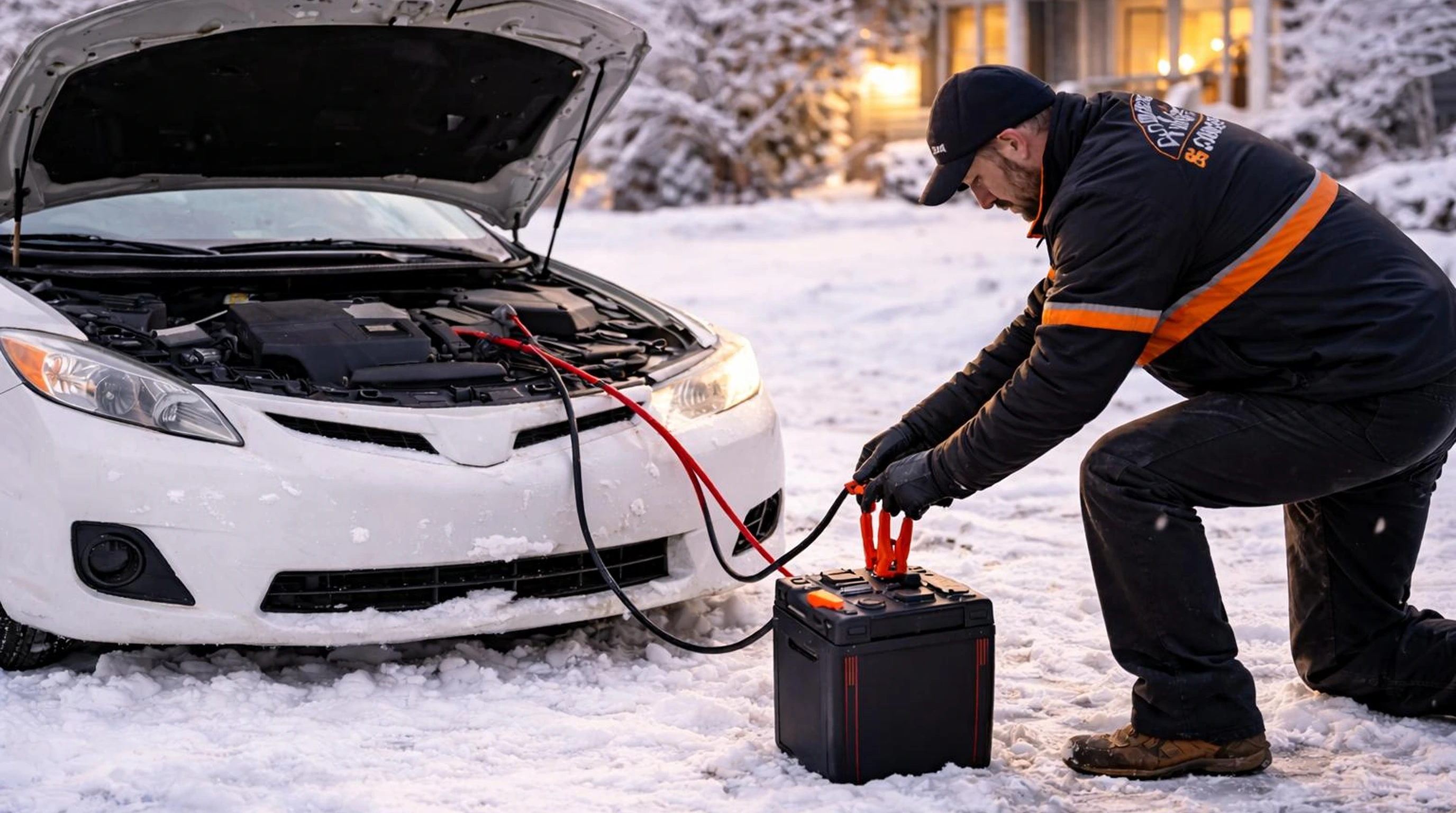
Winter Car Care: Why a Dead Battery Is Most Likely When It Is Cold
If your car has ever refused to start on a bitter January morning, you are not imagining a pattern. Cold weather is the single most common reason batteries fail, and in a Canadian winter the odds stack up fast. Understanding why it happens, and what you can do about it, is the difference between a smooth commute and standing in a frozen driveway waiting for help.
Why cold weather drains your battery
A car battery makes power through a chemical reaction, and like most chemistry, that reaction slows down as the temperature falls. At minus 18, a typical battery can lose around a third of its available power. At colder temperatures still, common across much of the country in deep winter, the loss is greater.
At the same time, your engine is harder to start in the cold. Engine oil thickens as it chills, so the starter motor has to work harder and draw more current. So winter creates a cruel mismatch: your battery has less to give exactly when your engine is asking for more. That is why a battery that seemed fine in November suddenly quits in January.
The warning signs worth catching early
Batteries rarely die without warning. Watch for a slow, laboured cranking sound when you start the car, headlights that dim at idle, or electronics that reset or act up. A battery that is more than three or four years old is also living on borrowed time, since age and cold together are a common failure combination. If you notice any of these, it is worth testing the battery before the coldest weeks arrive rather than after.
How to protect your battery through winter
A few simple habits go a long way:
- Park inside when you can. Even an unheated garage is several degrees warmer than an open driveway, and that margin matters.
- Drive long enough to recharge. Short trips do not give the alternator time to top up the battery. If most of your driving is quick errands, take the occasional longer drive.
- Keep the terminals clean. Corrosion adds resistance and weakens the connection. A quick check and clean in late fall is cheap insurance.
- Turn off accessories before shutting down. Heated seats, defrosters, and the radio all draw power. Switching them off before you turn the key eases the load on the next start.
- Test the battery in the fall. Many shops do this for free. Knowing your battery's health before winter beats discovering it at minus 25.
Have a backup that actually works in the cold
Even a well-maintained battery can be caught out by an extreme cold snap, so a portable jump starter belongs in every winter vehicle. The key word is portable. A traditional lead-acid booster is heavy, and worse, it loses its own charge in the cold and after sitting unused, which is exactly the situation you would be counting on it.
A compact lithium jump starter solves both problems. It holds its charge for months, performs far better in the cold, and is small enough to keep in your glovebox all season. For most cars and smaller vehicles, the Jump Juice JJ010 is an easy everyday choice. If you drive a truck or a larger engine, step up to the JJ012 or JJ013 for the extra cranking power a cold diesel can demand.
There is a bonus, too. A quality lithium starter like the JJ011 doubles as a power bank and a bright LED flashlight, so it earns its place in your car long before you ever need a jump. When you are stopped on a dark shoulder in a snowstorm, having light and a way to charge your phone is not a luxury.
A simple winter routine
Put it all together and your cold-weather plan is short: test the battery in the fall, keep up a few good habits through the season, and carry a lithium jump starter that is ready when you are. That combination handles the vast majority of winter no-start situations before they turn into a bad morning.
Cold weather is not going anywhere, but a dead battery on the coldest day of the year is a problem you can plan around. A little preparation now means you spend winter mornings getting where you are going, not waiting for a boost.
Not sure which Jump Juice model fits your vehicle? Get in touch and our team will be glad to help.