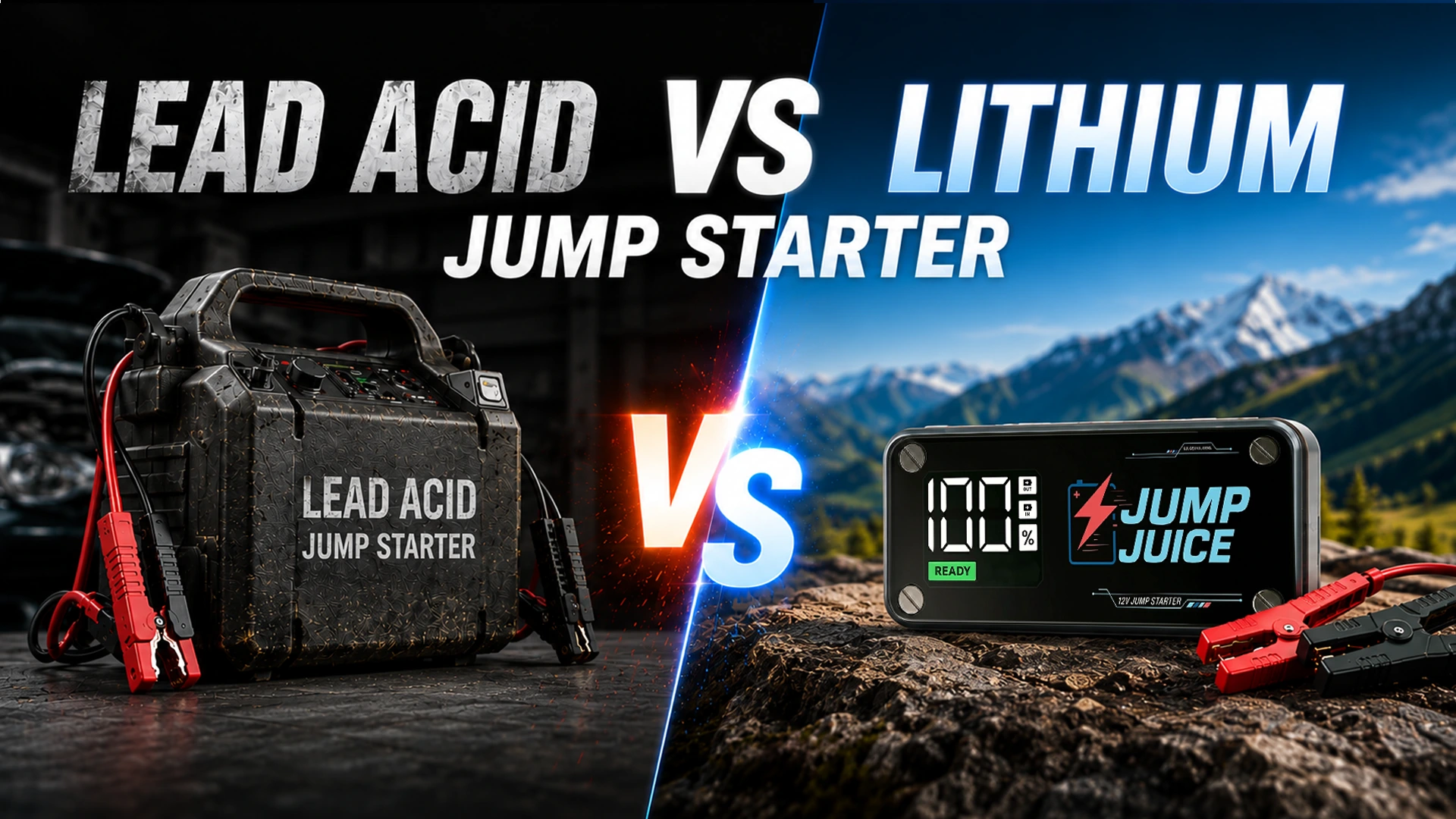
Lithium vs. Traditional Jump Starters: What Actually Matters for Canadian Drivers
Shop for a jump starter today and you will see two very different options. On one side are the traditional units many of us grew up with: heavy, boxy, and built around the same lead-acid chemistry as the battery under your hood. On the other are compact lithium jump starters small enough to keep in your glovebox. Both promise to get your engine running when the battery quits, but how they do it, and what they cost you in weight, reliability, and everyday usefulness, is where they part ways.
Here is a straightforward breakdown for drivers who want a tool that works when it counts, especially through a Canadian winter.
The core difference: chemistry
A traditional jump starter is basically a portable lead-acid battery, the same technology already under your hood. It is proven and inexpensive, but heavy, poor in the cold, and quick to lose its charge on the shelf. A lithium jump starter uses lithium-ion cells, the same family that powers your phone and laptop. Lithium holds far more energy in far less space and weight, and that one fact drives nearly every advantage below.
1. Weight and portability
A lead-acid unit can weigh 7 to 11 kilograms. A lithium unit with comparable power often weighs under a kilogram and fits in your hand. That matters because a jump starter is only useful if it is with you when the battery dies, and the heavy box in the garage does you no good at 11 p.m. in a grocery store parking lot in February. A compact unit like the Jump Juice JJ010 is small enough to live in your glovebox, so it is always there.
2. Starting power
It is fair to wonder whether something so small can crank an engine. It can. High-output lithium cells deliver hundreds of amps of peak current, enough to turn over most gas engines and many diesels several times on one charge. Watch the peak amps and the rated engine size. Larger diesels need more current, so for a truck or equipment rather than a sedan, step up to a higher-capacity model like the JJ012 or JJ013.
3. Cold-weather performance
This is the part that matters most in this country. Your battery is most likely to die when it is cold, and cold is exactly when lead-acid struggles. Well below zero, the reaction inside a lead-acid battery slows and its cranking power drops right when you need it. Anyone who has tried to start a car on a minus 25 morning knows the feeling. Lithium cells hold up far better in the cold, and quality units protect the cells at temperature extremes. For Canadian drivers, this alone is a strong reason to go lithium.
4. Readiness after storage
Leave a lead-acid unit unused for a few months and it will likely be flat when you finally reach for it. Lithium cells lose their charge much more slowly and stay ready for many months, so a lithium starter left in your vehicle is far more likely to actually work after a quiet stretch. That is the whole reason you bought one.
5. It is more than a jump starter
A lead-acid unit does one job. A lithium jump starter does several. Built like a power bank, it charges your phone, tablet, and other devices through USB, which is handy on road trips or during an outage. Most quality units, including the Jump Juice range, also include a built-in LED flashlight for night-time roadside situations. The JJ011 is a good example of this all-in-one approach.
6. Safety
Older units put a lot on the user, and a reverse-polarity mistake could mean sparks or damage. Modern lithium units build the safety in, with protection against reverse polarity, short circuit, and overcharging, all standard across the Jump Juice line. Even if you connect the clamps wrong in the dark, the unit is designed to prevent a disaster. For a device used rarely and usually under stress, that is worth a great deal.
7. Lifespan and value
Traditional units cost less up front, which is their main appeal. But lead-acid batteries wear out faster, especially if left discharged, while lithium cells last through many more charge cycles and store far better. The higher initial price is often offset over the life of the device. A cheaper unit that is dead when you need it has cost you far more than its price tag.
Quick comparison
| What matters | Traditional (lead-acid) | Lithium |
|---|---|---|
| Weight | Heavy (7 to 11 kg) | Light (under 1 kg) |
| Portability | Lives in the garage | Fits in your glovebox |
| Cold performance | Weakens | Holds up well |
| Readiness | Needs regular charging | Ready for months |
| Extra functions | Jump start only | Jump start, power bank, flashlight |
| Built-in safety | Limited | Reverse-polarity, short-circuit, overcharge |
| Up-front cost | Lower | Higher, longer life |
So which should you choose?
For most drivers, a lithium jump starter is the more practical tool: light enough to always keep with you, reliable after long storage, safer to use, and useful well beyond the one emergency it was bought for. A traditional unit still suits a fixed garage where weight and cold are not concerns, but for real-world readiness on Canadian roads, lithium is the clear choice.
Ready to make the switch? Match a model to your vehicle:
- JJ010 — everyday carry for cars and smaller vehicles
- JJ011 — all-in-one starter, power bank, and flashlight
- JJ012 — higher capacity for larger engines
- JJ013 — maximum power for trucks and equipment
The best jump starter is the one that is charged, in your vehicle, and ready when the battery is not.
Not sure which model fits your vehicle? Get in touch and our team will be glad to help.